What a perpetual future and the funding rate are
A perpetual future has no expiry date, so its price is tied to spot by the funding rate — a regular payment between longs and shorts. We look at who pays whom, how a payment is calculated and where the rate itself comes from.

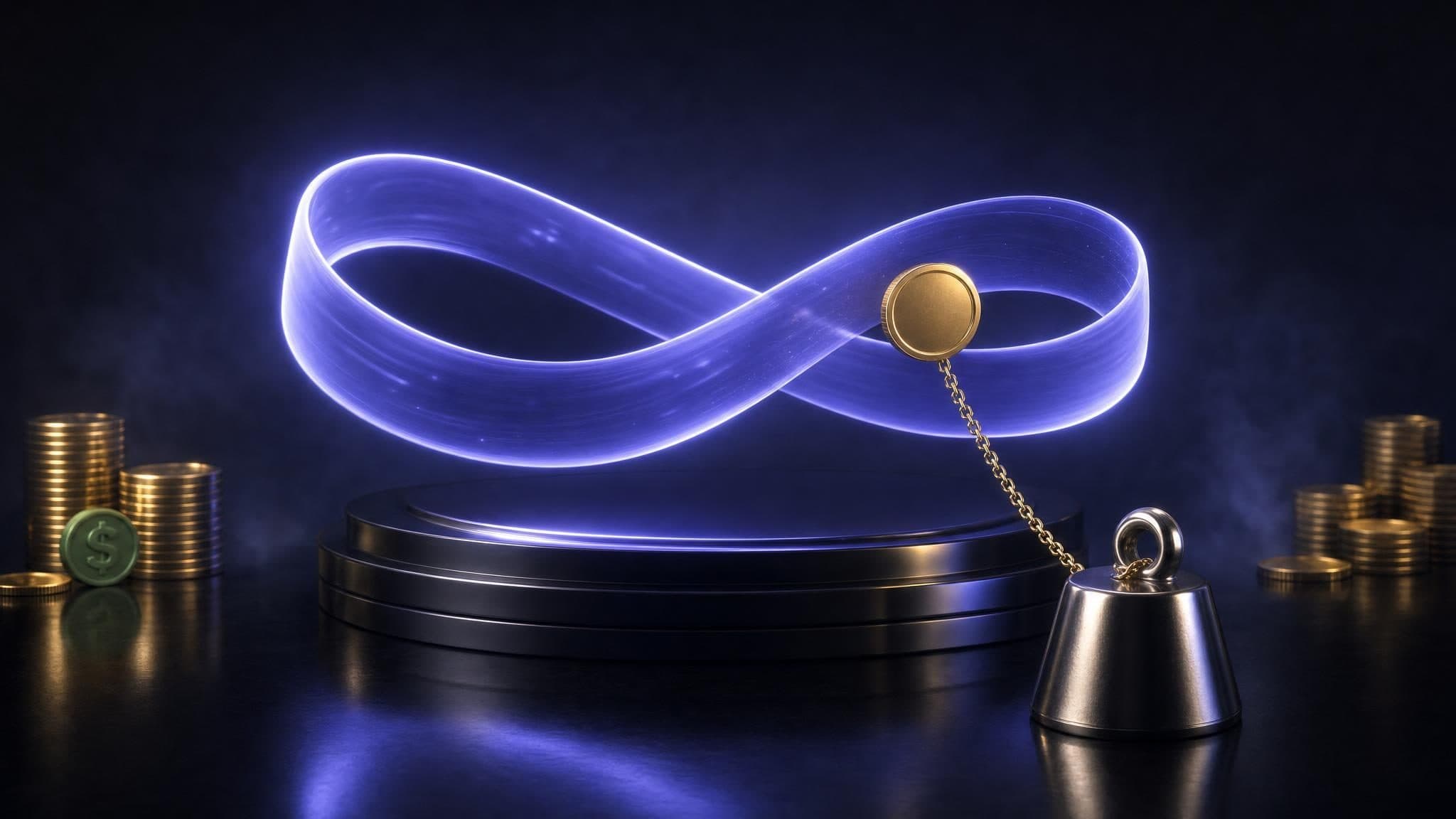
This is the first lesson of the funding rate arbitrage course. First, the instrument itself: what a perpetual future is, why it needs funding and how a payment is calculated. Without this, any setup in the scanner is just a set of percentages.
A perpetual future in plain words
A future is a contract on an asset’s price: you do not buy the coin itself but open a position that profits from the price going up (long) or down (short). A regular dated future has an expiry date, and by then its price converges with spot. A perpetual future (perpetual swap, “perp”) has no expiry: you can hold the position as long as your margin lasts.
BitMEX launched the first perpetual swap in 2016 — the exchange itself wound down in September 2026, while the instrument outlived it and became the most traded on crypto exchanges: it offers leverage, lets you profit from falling prices, and margin is usually in USDT or USDC (linear contracts) or in the coin itself (inverse contracts).
What the funding rate is
With no expiry, something has to keep the perp’s price close to spot. That job belongs to the funding rate — a regular payment between holders of longs and shorts.
- The perp trades above spot — there are more longs than shorts. The rate is positive: longs pay shorts. Holding a long gets more expensive, opening a short gets more attractive, and the perp price is pulled down toward spot.
- The perp trades below spot — shorts dominate. The rate is negative: shorts pay longs, and the price is pulled up.
The exchange is not a party to this payment: money moves from some traders to others, and the exchange takes no fee on funding. That is exactly why funding can be collected — you just need to be on the side that gets paid.
How a payment is calculated
Payment = position value × funding rate. Position value is calculated at the mark price at the funding timestamp. Leverage does not affect the payment directly: what matters is position size, not the margin amount.
| 8h rate | One payment | Per day (3 payments) | Annualized |
|---|---|---|---|
| +0.01% | $1.00 | $3.00 | +10.95% |
| +0.03% | $3.00 | $9.00 | +32.85% |
| +0.10% | $10.00 | $30.00 | +109.50% |
| −0.01% | −$1.00 | −$3.00 | −10.95% |
Only a trader whose position is open at the funding timestamp pays or receives. Open a minute before it and you get or pay the full payment for the interval. Close a minute before and you get nothing.
Where the rate comes from: Binance’s formula as an example
Every exchange has its own formula, but the idea is the same. On Binance USDⓈ-M futures the rate has two parts:
- Premium index — how far the perp price deviates from the index price (the average spot price across several exchanges).
- Interest rate — 0.01% per 8 hours (0.03% a day): a nominal difference in the cost of money between USDT and the coin.
Rate = premium index + clamp(interest rate − premium index, −0.05% to +0.05%). If the premium stays close to the interest rate, the clamp returns exactly 0.01%. That is why most coins sit at the baseline 0.01% most of the time, and noticeable deviations appear when one coin’s market is skewed. For intervals shorter than 8 hours the rate is scaled down: divided by 2 at 4 hours and by 8 at 1 hour. On top of that, every contract has a cap and a floor: for some coins it is ±0.75 × the maintenance margin rate, for the rest ±2% per interval.
Funding intervals
The industry standard is funding every 8 hours: on Binance and Bybit that is 00:00, 08:00 and 16:00 UTC. Some contracts use 4-hour or 1-hour intervals. If the rate hits its cap or floor, exchanges shorten the interval on the fly: Binance and Gate move such a contract to hourly funding, OKX steps down 8 → 4 → 2 → 1 hours, and Bitget announces changes per contract. Decentralized Hyperliquid and dYdX charge funding every hour; on Hyperliquid the rate is capped at 4% per hour. So rates on different exchanges can only be compared over the same period — more on that in lesson 5.
Why rates differ between exchanges
Each exchange has its own traders, its own long/short imbalance, formula, index, cap and interval. On one exchange a coin may pay shorts +0.05% per 8 hours, while on another it pays longs. The rate difference between exchanges, and between the future and spot, is what funding arbitrage collects. How exactly — in the next lesson.
Frequently asked questions
What is the funding rate in simple terms?
A regular payment between holders of longs and shorts on perpetual futures. It keeps the contract price close to spot: when the future trades higher, longs pay; when it trades lower, shorts pay.
Who pays when funding is positive?
Longs pay shorts. When it is negative, it is the other way round: shorts pay longs. The exchange only passes the payment along and takes no fee on it.
How often is funding charged?
Most often every 8 hours (on Binance and Bybit at 00:00, 08:00 and 16:00 UTC). Some contracts use 4-hour or 1-hour intervals; Hyperliquid and dYdX charge every hour.
Do I need to hold the position for the whole interval to get paid?
No. The payment goes to whoever has a position open at the funding timestamp. But short holding means paying fees and risking price moves — more on that in lesson 2.
Does leverage affect the payment size?
The payment is calculated on position value, not margin. With leverage the same margin gives a larger position and a larger payment — but liquidation is closer too.
Sources
- 1.Introduction to Binance Futures Funding RatesBinance3/6/2026official
- 2.
- 3.Perpetual funding fee mechanismOKX10/28/2026
- 4.
- 5.Funding | Hyperliquid DocsHyperliquid
- 6.
- 7.What Are Mark Price and Price Index in USDⓈ-Margined Futures?Binance9/25/2026
- 8.BitMEX: exchange operations wound down (homepage notice)BitMEX9/23/2026
- 9.P2P.Army: funding FAQP2P.Army10/31/2026
About the author

Crypto expert, arbitrage trader and investor
Crypto expert and hands-on crypto arbitrage trader, investor and software developer with over 20 years of experience. On the P2P.Army blog he covers exchange news, P2P and cross-exchange arbitrage.
- Crypto arbitrage
- P2P arbitrage
- Cross-exchange arbitrage
- Crypto exchanges
- Investing
- Software development