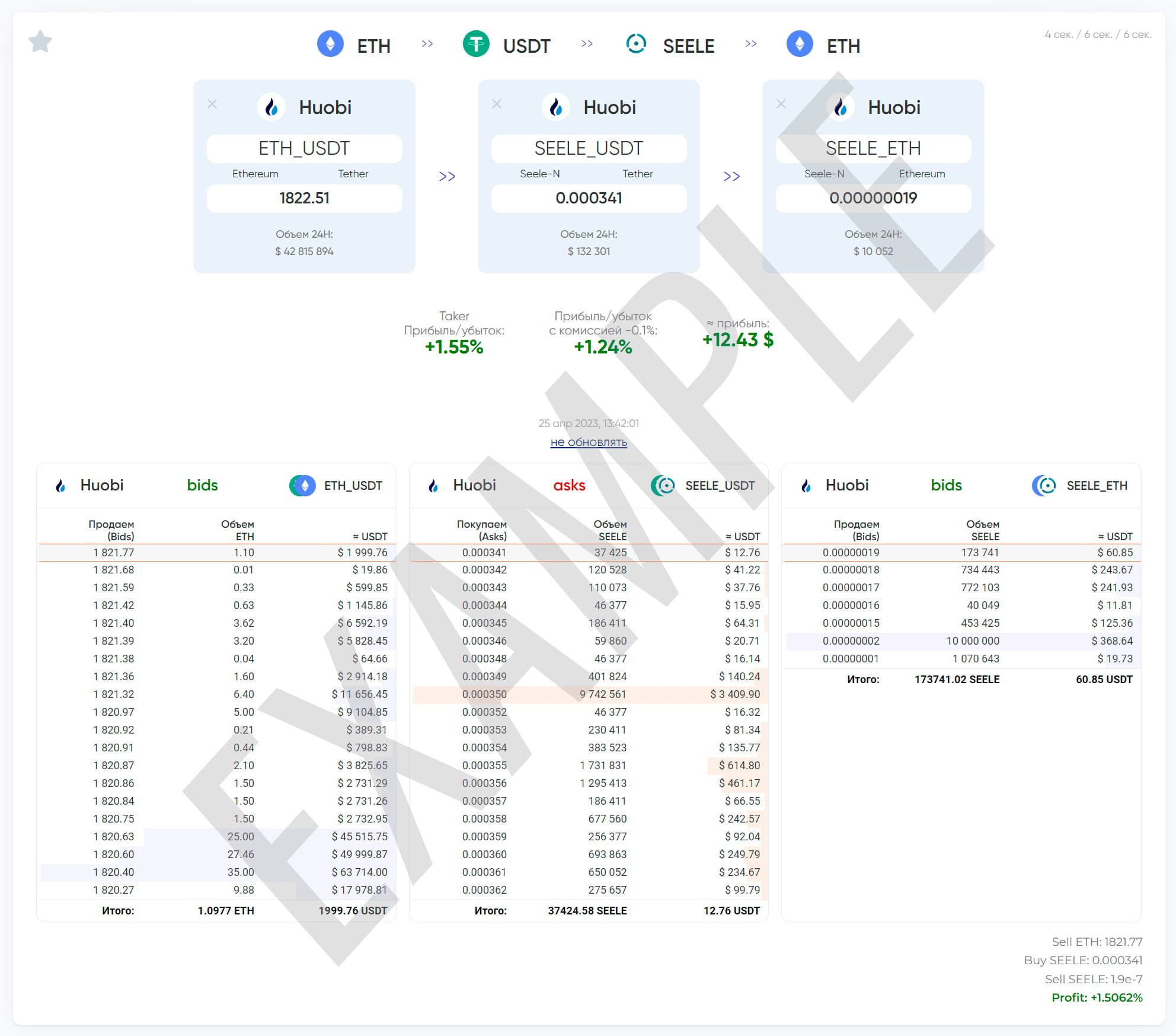
Inter-exchange arbitrage: 2 exchanges
Buy an asset on exchange #1, transfer it and sell higher on exchange #2. The clearest mode.
Arbitrage scanner features
Trading assets without cards
Inter-exchange arbitrage directly via crypto, without bank cards.
More than 50 crypto exchanges
The largest crypto exchanges combined in a single scanner.
More than 3000 assets
Thousands of trading pairs tracked in real time.
Deposit & withdrawal info
Information about deposit and withdrawal of cryptocurrency.
Transfer commissions
Information about commissions for transfers between exchanges.
Order book viewing
Simultaneous order book viewing before making a deal.
Statistics of positive arbitrage opportunities
4 ways to profit from arbitrage
From simple single-exchange chains to complex multi-exchange schemes. Each mode supports maker/taker selection — pick the strategy that fits your style.
Single exchange
Find a chain and profit within one exchange — no transfers between platforms.
2 exchanges + transfer
Buy on exchange #1, transfer the asset to exchange #2 and sell higher.
3 exchanges + transfer
Buy on exchange #1, transfer to exchange #2, make a swap and sell.
4 exchanges + transfer
Buy on exchange #1, swap, transfer to exchange #2, swap again and sell.
More than 40 exchanges
All exchanges have an order book view function before making a deal, but not all exchanges have network analysis for transfer and their commissions.


Liability Notice
Inter-exchange arbitrage carries high risks! To work successfully with inter-exchange arbitrage, deep knowledge of trading, understanding of the order book, orders, blockchain networks, crypto exchanges, and a high level of concentration are required.
All arbitrage opportunities offered by the system were generated automatically without human verification! Therefore, an additional check of each of your trades is mandatory!
P2P.Army bears no responsibility in case of loss of your funds! P2P.Army offers only analytical information that must be double-checked. The tool can be used with both positive and negative results.
What should you pay attention to?
Before performing a trade, we recommend triple-checking:
- Check the order volumes in the exchange's order books. The order size must be larger than your trade.
- Before buying a coin, make sure you can sell it at a reasonable price on the same exchange. It often happens that if you buy a coin, you can only sell it at a huge loss because there are no buyers.
- Before buying a coin, you need to ensure that you can withdraw it from the exchange and deposit it into another exchange.
- Before transferring a coin, pay attention to the "Minimum Deposit Amount" on exchange #2. This is an invisible pitfall that can lead to loss of funds.
Too large a spread?
If you see an unusually large spread for a single coin on different exchanges, the reasons are most likely:
- Different coins, but same tickers!We try to maintain an up-to-date database of coins, but 100% accuracy is very difficult to provide.
- Low liquidity!For example, there are orders totaling $1 at good prices, and behind them, orders are 90% cheaper. In this case, you could lose 90% of your funds.
- Deposit disabled!The coin cannot be deposited into the exchange account.
- Withdrawal disabled!The coin cannot be withdrawn from the liquid exchange account.
- High volatility!Arbitrage opportunities often appear during a sharp market fall or rise. While funds are being transferred from one exchange to another, prices may drop or recover 1:1.
- High commissionHigh commission for withdrawing a coin or a high minimum deposit amount.
- Deposit/transfer delay!Sometimes "bad" exchanges pause deposits but claim they are working. They inflate the price for N hours, arbitrageurs deposit the coin but cannot trade. After N hours, they unfreeze and lower the coin price.
Recommendations
Risk Management
The first trade should always be carried out with money you are prepared to lose. Especially on a new, unfamiliar exchange.
Caution
The smaller the exchange, the more often it tries to deceive you and take your coins. Be careful!
Realism
A normal profit percentage for each trade is 0.1 - 1%. If you are looking for trades from 3% and above, it is likely a system error or a trap.
Bypassing bots
On small exchanges, algorithms often place small orders (1-30 USDT) to simulate liquidity.
Impact of deposit on profitability
Your profitability when working with small spreads directly depends on the deposit size.
Tool screenshots