

Catch mispriced crypto options across four exchanges
The same option often costs differently on Deribit, Bybit, OKX and Binance. P2P.Army matches identical contracts, shows the spread you can actually execute after fees and checks put-call parity on every exchange — 1,000+ cross-exchange pairs and 2,700+ parity combos, refreshed in seconds.
This is what you get after payment
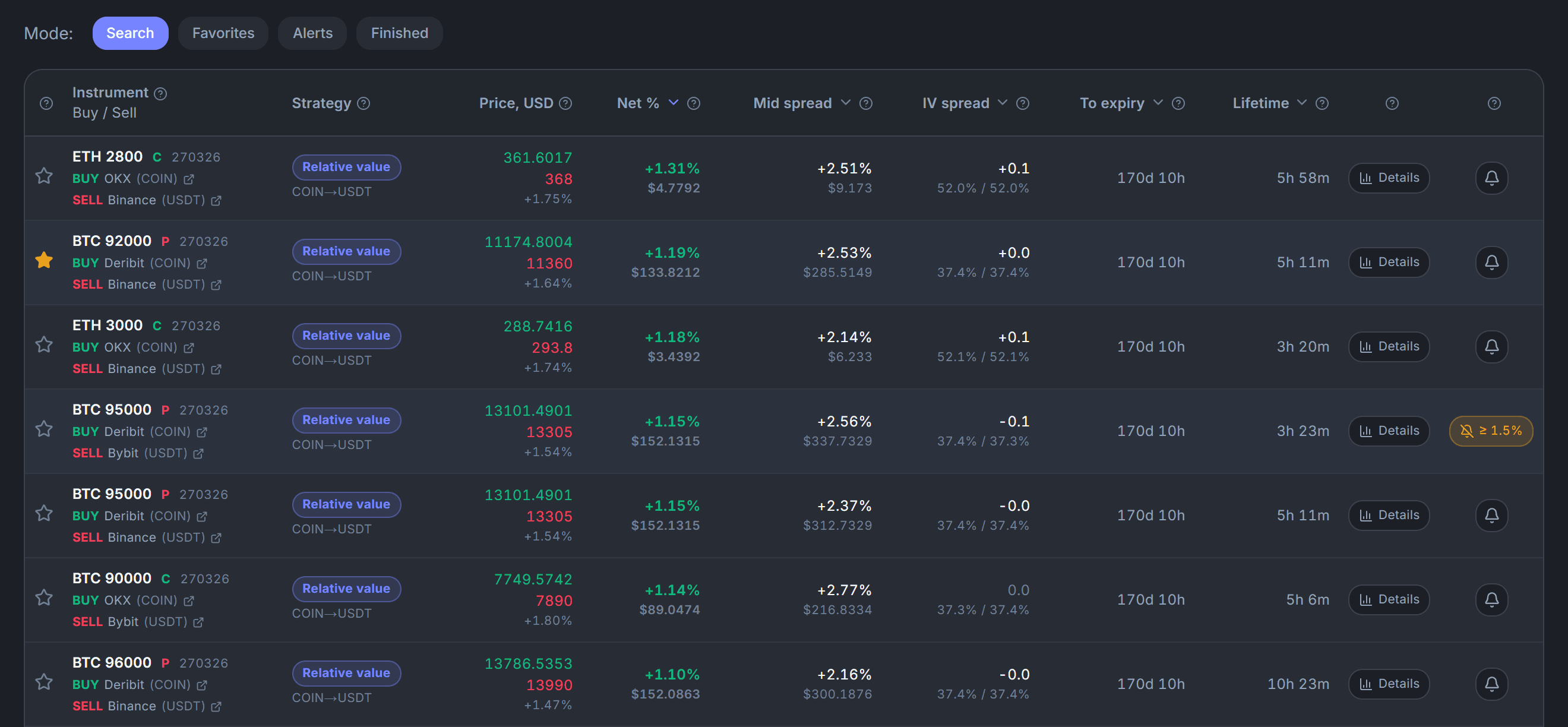
Real screenshots of the options scanner with live data. Click the numbers to see what every element does.
Identical options, different prices
Every row is one contract — same underlying, strike and expiry — listed on two exchanges. Buy where it is cheaper, sell where it is more expensive; the table shows what is left after fees.
- 1Underlying, strike, call/put and expiry, plus which exchange to buy on and which to sell on
- 2Signal type: true lock, relative value, watch or IV only
- 3Ask on the buy exchange and bid on the sell exchange, in USD
- 4Net spread after fees of both legs — executable, not theoretical
- 5Spread by mid prices — useful when order books are wide
- 6Implied-volatility gap between the two exchanges
- 7Time left to expiry
- 8Open the full card of the pair: legs, Greeks, history
- 9Set an alert — the bot writes when the spread reaches your level
Where does the profit come from?
Real pairs from the scanner (2026-10-06). Pick one and change the number of contracts — the calculation uses bid and ask, not mid prices, and includes fees.
- Buy on Deribitat ask $11,174.80−$11,174.80
- Sell on Binanceat bid $11,360.00+$11,360.00
- Feesboth legs, as estimated by the scanner−$51.38
By mid prices the gap looks like +$285.51, but you trade at bid and ask: +$185.20 before fees. That is why the scanner ranks by executable net spread.
The legs settle in COIN and USDT — different instruments, so this is relative value, not a pure lock. Keep margin on both exchanges.
Snapshot of real quotes; prices move every second. Not investment advice — options involve margin and liquidation risk.
What is options arbitrage?
Options are one of the fastest-growing corners of crypto. Because the market is young and split across many exchanges, the very same contract is often priced differently from one venue to another. Options arbitrage is the practice of spotting those gaps — in price or in implied volatility — and trading them.
This tool does the hard part for you: it watches four exchanges around the clock, lines up identical contracts (same coin, strike and expiry), and labels every gap by how tradeable it really is. Below is everything a newcomer needs to get started.
Signal types
True lock
Same settlement, positive after fees — a rare near risk-free lock (e.g. a market maker dropped out).
Relative value
Positive after fees but cross-settlement (COIN↔USDT): relative value with basis/currency risk.
Watch
There is a price crossing, but fees eat it — worth watching.
IV only
No price crossing, but a notable implied-volatility gap between exchanges.
Put-call parity — arbitrage inside one exchange
Same-strike call vs put vs the underlying — single-exchange synthetic arbitrage (conversion / reversal). All three legs on one venue, so margin nets.
For the same strike and expiry, a call minus a put behaves like the underlying: Call − Put = Spot − Strike (crypto, short-dated). When this relationship breaks, you can lock a profit with three legs on a single exchange.
Conversion (call is rich): sell the call, buy the put, buy the underlying (spot or perp). At expiry the legs settle against the same price and you keep the locked difference.
Reversal (call is cheap): buy the call, sell the put, short the underlying.
Because all three legs are on ONE exchange, margin nets across them — no cross-exchange liquidation risk, unlike cross-venue option spreads.
The strike nearest to spot (ATM) is the most liquid and reliable. Use the % from ATM filter to stay near the money.
Signals and alerts straight to Telegram
Subscribe once — the bot sends new pairs that pass your filters, and personal alerts when a watched pair reaches your threshold.
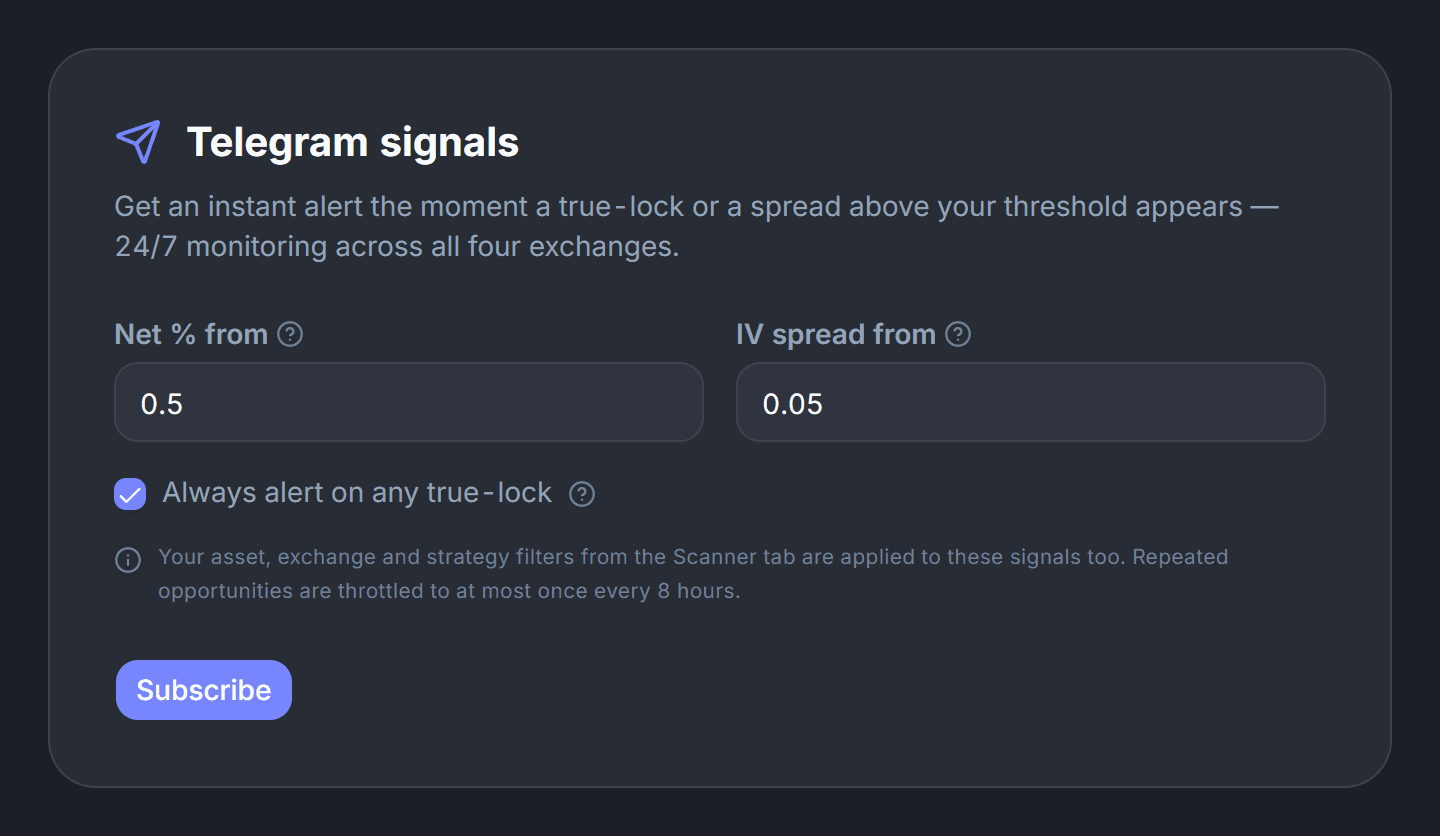
Set the minimum net spread and IV gap; true-lock signals can always come through.
🟠
BTC 92000P 270326Relative value
Buy: Deribit (COIN)
Sell: Binance (USDT)
net:
1.1877% gross: 1.6437%IV-spread:
0.03More
🟠
ETH 2800C 270326Relative value
Buy: OKX (COIN)
Sell: Binance (USDT)
net:
1.3101% gross: 1.7539%IV-spread:
0.05More
/disable_options_signals - Disable these notifications
Settings on P2P.Army09:41
BTC 95000P 270326Relative value
Buy: Deribit (COIN)
Sell: Bybit (USDT)
net:
1.1522% gross: 1.5414%IV-spread:
-0.12More
Net % threshold:
1.0000%14:26What the scanner gives you
Cross-exchange spread scanner
Matches identical contracts across four venues and shows the executable spread — the bid on one exchange against the ask on the other, after fees — not a cosmetic gap between mid prices.
Put-call parity & synthetics
Conversion and reversal inside a single exchange: call, put and the underlying at the same strike. All three legs sit on one venue, so margin nets and there is no cross-exchange liquidation risk.
Every listed underlying
No longer BTC and ETH only. SOL, XRP, DOGE and any other underlying quoted on at least two venues show up automatically as the exchanges list them.
Mid-price spread
When order books are wide, the executable spread hides the real dislocation. The mid spread — (bid+ask)/2 on each leg — exposes it, and sorts side by side with the net spread.
Implied-volatility dispersion
The IV gap on one and the same contract between venues. Often the cleanest sign of a stale or mispriced book, even when the cash spread still looks small.
Spread history & charts
Every bundle is snapshotted on a 15-minute grid, so you can tell a one-off print from a dislocation that has been open for hours — for both cross-exchange spreads and parity deviations.
Telegram alerts & signals
Personal thresholds per bundle (net %, IV spread) plus a subscription to true-lock events with your own filters. Real dislocations appear at night and during shocks — the bot does not sleep.
Filters, favorites & greeks
Filter by underlying, option type, signal class, exchanges, minimum net %, IV spread, distance from ATM and days to expiry. Save bundles to favorites; every card shows both legs with bid/ask, IV, delta, gamma, theta, vega and open interest.
How to start
- 01
Open the scanner
Pick an underlying and a signal class — start with true-lock and relative value, they are the most actionable.
- 02
Open the bundle card
Both legs, greeks, implied volatility, moneyness and the spread history are on one page, with a step-by-step guide on how the trade is put on.
- 03
Set an alert
Give the bundle a net % or IV threshold and connect Telegram — the bot pings you when the spread widens to your level.
How it works & risks
The scanner matches identical options (same underlying, strike, expiry) across exchanges and shows the executable spread (buy at ask on one venue, sell at bid on the other) and the implied-volatility gap. A truly risk-free lock is rare: cross-exchange margin on the short leg is not netted against the long leg on another venue, and coin-settled vs USDT-settled options are different instruments (basis/currency risk). Fees and slippage beyond top-of-book also apply. Use true-lock alerts to catch the rare dislocations; treat other rows as relative-value signals, not guaranteed profit.
Everything included in the plan
The options scanner comes with the DEX/CEX plan together with the futures screener and funding-rate arbitrage. The Ultimate plan includes it as well.
Get access- Cross-exchange scanner on 4 exchanges
- Put-call parity on every exchange
- 6 underlyings: BTC, DOGE, ETH, SOL, XAU, XRP
- Executable net spread after fees and mid spread
- Implied-volatility dispersion
- 48-hour spread history in charts
- Favorites and personal alerts
- Telegram signals 24/7
Exchanges we track
 Deribit
 Bybit
Bybit OKX
OKX Binance
Options arbitrage FAQ — for beginners
- Cross-exchange margin: the short leg's margin can balloon on one exchange while your offsetting gain sits on another — they do not net, so you can be liquidated.
- Settlement currency: a coin-settled option and a USDT-settled one are different instruments (basis / currency risk).
- Fees and slippage beyond the top of the book can erase a thin spread.
