

Profit from price gaps in crypto
The same coin trades at different prices on different exchanges and markets. P2P Army scans 40+ exchanges around the clock, finds these gaps and calculates the net profit after all fees — across four types of arbitrage.
P2P Army is not an exchange: we find the opportunities, you trade on your own accounts.
What arbitrage is and how we help
Arbitrage means buying an asset where it is cheaper and selling it where it is more expensive. The profit comes from the price gap, not from guessing where the market goes.
- 1
We scan the markets
Every few seconds we collect prices, ads, order books and funding rates from 40+ exchanges and 9 P2P markets.
- 2
We calculate the net profit
We subtract trading fees, gas and withdrawal costs and check that networks are open, so you only see real opportunities.
- 3
You capture the spread
You trade on your own exchange accounts or get a Telegram alert the moment an opportunity appears.
Four types of arbitrage, one platform
Choose the strategy that fits your capital and experience — each comes with its own set of tools.
Buy crypto cheaper and sell higher on P2P markets
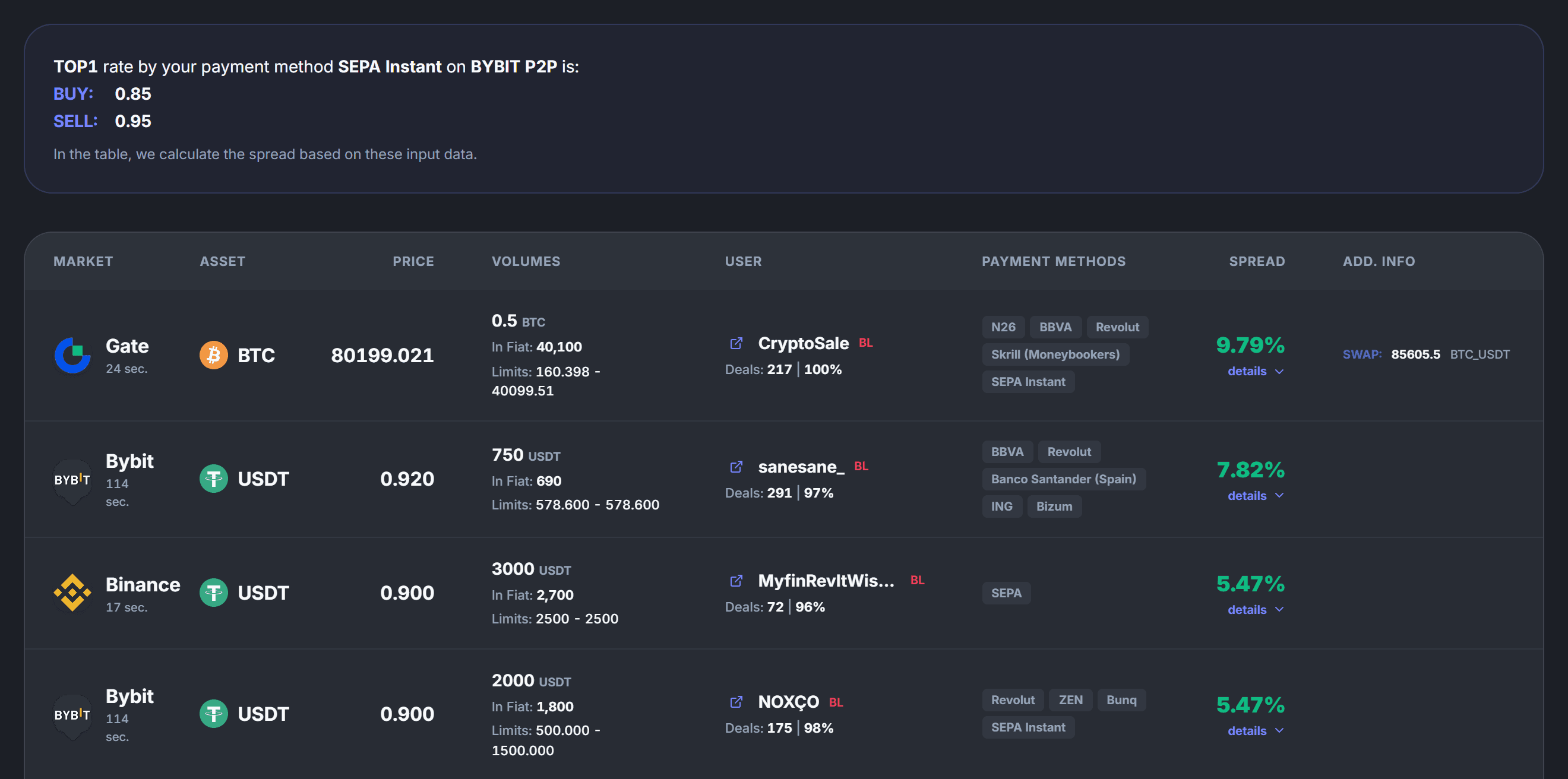
On the P2P markets of Binance, Bybit, OKX and other exchanges, people buy and sell USDT, BTC and other coins from each other for local currency via banks and payment apps. Prices differ between sellers, so an arbitrageur buys from one ad and sells to another — on the same exchange or a different one.
- 1Buy USDT for fiat
- 2Sell it higher to another buyer
- 3The gap is your profit
The best P2P opportunities for your payment method, with the spread already calculated
Order books of several P2P exchanges side by side, filtered by bank
Buy/sell spreads on every exchange and currency
Exchange routes between currencies of different countries via P2P
One coin, different prices on different exchanges
Centralized exchanges each live their own life, so the price of the same coin drifts apart. Buy where it is cheaper, transfer the coin and sell where it is more expensive. The scanner builds routes through 2, 3 and 4 exchanges and accounts for fees and the status of withdrawal networks.
- 1Buy on exchange A
- 2Transfer the coin
- 3Sell on exchange B

Catch the gap between DEX and centralized exchanges
Tokens trade at the same time in decentralized exchange pools and on CEX order books, and the prices regularly diverge. Buy on Uniswap or PancakeSwap and sell on a CEX, or the other way round. The spread is shown after gas and withdrawal fees.
- 1Buy in a DEX pool
- 2Transfer on-chain
- 3Sell on a CEX

Earn funding without betting on market direction
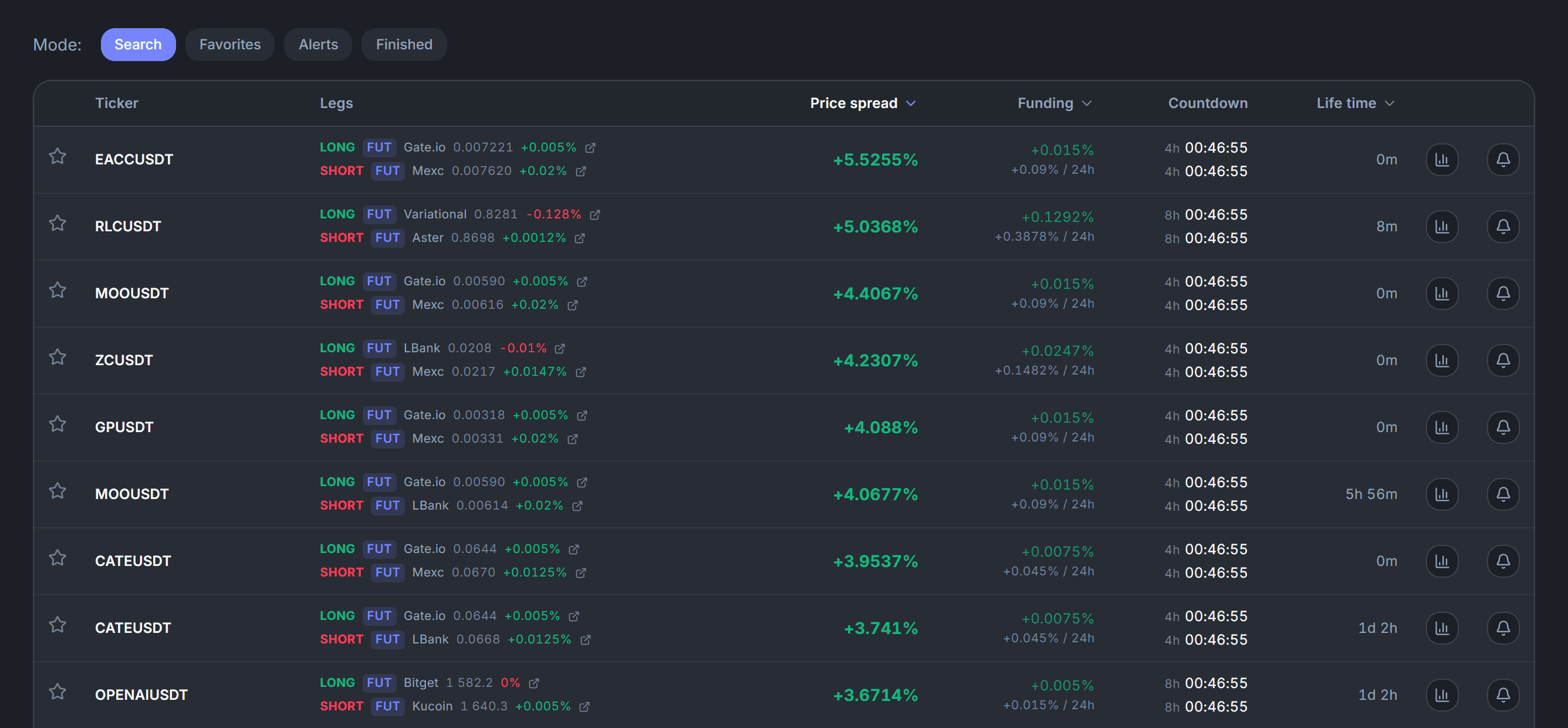
On perpetual futures, exchanges pay a funding rate every few hours, and it differs from exchange to exchange. Open a long where funding is paid to you and a short on the same coin on another exchange: the position is price-neutral, and you collect the difference in rates and prices.
- 1Long on exchange A
- 2Short on exchange B
- 3Collect the funding
Which arbitrage suits you
The four strategies differ in capital, speed and risk. Compare them before you start.
| P2P arbitrage | CEX arbitrage | DEX arbitrage | Futures arbitrage | |
|---|---|---|---|---|
| Where the gap comes from | Between sellers on P2P markets, in fiat | Between centralized exchanges | Between DEX pools and CEX order books | Between funding rates and futures prices |
| What you need | P2P exchange accounts and bank cards or payment apps | Accounts on several exchanges and capital in USDT | A crypto wallet, a CEX account and some native token for gas | Futures accounts on two exchanges with margin on both |
| How long a trade takes | Minutes, while payments clear | Minutes to an hour, for the transfer | Minutes, for on-chain confirmation and the transfer | Hours to days, while you hold the positions |
| Main risks | Card blocks, dishonest counterparties | Closed withdrawal networks, price moves during the transfer | Gas, slippage, scam tokens | Liquidation with leverage, funding rate flips |
| Best for | People who work with fiat and local banks | Traders with capital in crypto | Those comfortable with wallets and networks | Those who want income independent of market direction |
P2P Army in numbers
We work with the exchanges you already use


What our users say
Thousands of traders and bloggers already earn with P2P.Army — here are their stories.

“On funding I have an average of $50 per day on a capital of $6,000. In general, I expected a similar result. Very convenient service.”

“It was an interesting experience, I will definitely continue to arbitrage DEX/CEX in the background using notifications from the bot as an additional income.”Read full

“Thanks to its extensive and convenient functionality, P2P Army really helps to earn money on arbitrage, which is confirmed by reviews of this system.”Read full

“The best service for finding and analyzing spreads around the world.”Read full

“A service that saves time, helps you find the most profitable deals and makes your operations as profitable as possible.”Read full

“Yo bro i actually liked the subscription bro this is the best Screener i have tried so i far to be honest you guys show stuff that no screener ever does bro”
“Tested the first transactions. Works awesome. Cool scanner.”
“P2P.Army is the best of all the offers on the market, incredibly convenient and fast.”

“P2P ARMY service, where you can view bundles in completely different variations. This service analyzes offers from all exchanges and for all banks and coins. It helps beginners a lot in their work.”Read full

“I have already subscribed to it, user friendly interface, there is still a lot of information about P2P arbitrage”Read full
Frequently asked questions
An analytics platform for crypto arbitrage. We collect prices from P2P markets, centralized and decentralized exchanges and futures, find price gaps and show where they can be captured — with all fees taken into account.
No. For arbitrage we do not take deposits or execute trades: you trade on your own exchange accounts, and P2P Army shows where the opportunity is. The only product that holds funds is our separate escrow service, and only for the duration of a deal.
Buying a coin where it is cheaper and selling it where it is more expensive. The profit comes from the price difference between markets, not from the price going up or down.
It depends on what you already work with. If you have bank cards and know P2P trading, start with P2P arbitrage. If your capital is already in USDT, start with inter-exchange CEX arbitrage. DEX arbitrage requires experience with wallets, and futures arbitrage requires an understanding of margin and leverage.
There are no guarantees: income depends on your capital, speed and strategy. A typical spread per trade ranges from a fraction of a percent to a few percent. The scanners show the profit after fees so you can assess it before you enter a trade.
No. The scanners sort opportunities by net profit, and every section explains its strategy. Experience helps with DEX and futures arbitrage.
You can start for free and without a card: the basic tools are open to everyone. The full scanners and Telegram signals are available on paid plans.
For P2P: Binance, Bybit, OKX, HTX, Bitget, MEXC, Gate, BingX and KuCoin. For spot: about 40 centralized exchanges. For DEX: Uniswap, PancakeSwap and other DEX on four blockchains. For futures: 28 exchanges.
Spreads are scanned continuously, and Telegram signals arrive within seconds after an opportunity appears.
