Cash-and-carry: the basis between spot and a quarterly future
Cash-and-carry is the only trade in this course where convergence is guaranteed by the contract rules: at expiry the dated future is settled against the index. We calculate it on real Binance prices from October 31, 2026 and see how much of 5% a year remains after fees and margin.

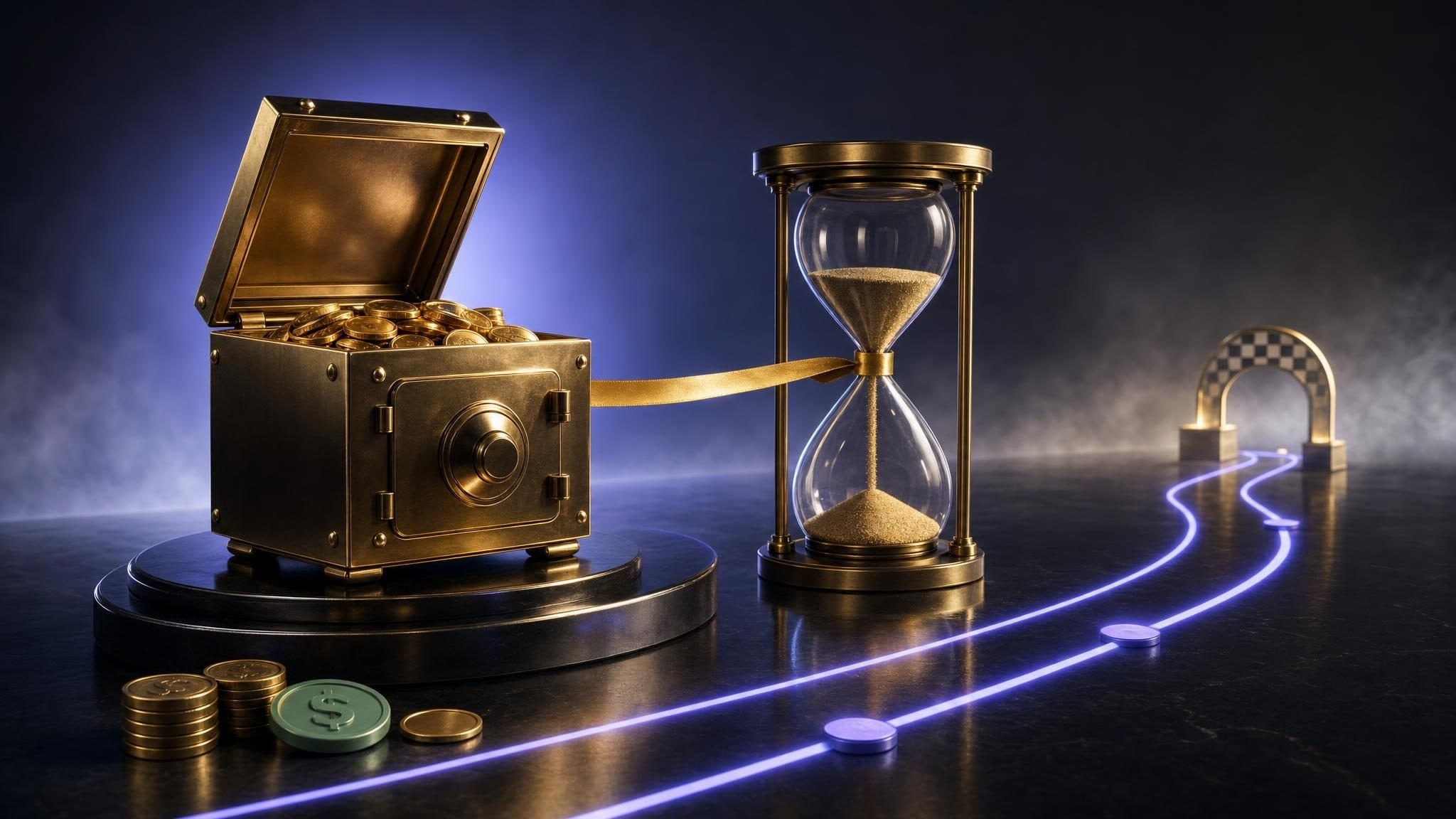
In lesson 1 we saw that the BTC quarterly future trades above spot. Cash-and-carry is the classic way to capture that gap: buy the asset now (“cash”), sell the future and hold the position to expiry (“carry”).
How the trade works
- 1
Buy spot
You buy the coin on spot at full value. - 2
Sell the dated future
You open a short for the same number of coins on the quarterly contract. The basis at that moment is your future income. - 3
Hold to expiry
The price can rise or fall: one leg’s profit cancels the other’s loss. The short needs margin the whole time. - 4
Expiry
Binance closes all open positions at the settlement price — the average index price sampled every second from 07:30 to 08:00 UTC — and charges a settlement fee at the taker rate. In the last 10 minutes before expiry positions can only be closed. You sell the spot at market at the same time — it is close to the settlement price.
Why the result does not depend on price: spot earns (price at expiry − purchase price), the short earns (futures sale price − price at expiry). Added together, the price at expiry cancels out, leaving the futures sale price minus the spot purchase price — the basis.
A calculation on real prices
As of October 31, 2026, 06:15 UTC, on Binance you could buy 1 BTC on spot at 77,302.50 and sell the December contract BTCUSDT_261225 at 77,910.3. Expiry on December 25 at 08:00 UTC was 55.1 days away.
| Item | Taker | Economical |
|---|---|---|
| Buy spot | 77,302.50 + 0.1% | 77,302.50 + 0.075% (BNB) |
| Sell the future | 77,910.3 − 0.05% | 77,910.3 − 0.02% (maker) |
| Basis | $607.80 | $607.80 |
| Fees: spot twice, future, settlement | −$233.12 | −$170.95 |
| Result before taxes | $374.68 | $436.85 |
| Of spot value | +0.48% (3.21% a year) | +0.57% (3.75% a year) |
| On capital with spot and 3× margin ($103,273) | +0.36% (2.40% a year) | +0.42% (2.80% a year) |
Of the basis’s 5.2% a year, 3.2–3.7% of spot value remains after fees, and 2.4–2.8% on all the capital involved. This is not “free money” but the market’s payment for holding the asset and margin until expiry. Compare it with what the same money could earn without exchange risk: in August 2026, according to CoinDesk, the three-month BTC basis of about 3% a year was below the yield on two-year US Treasuries (about 3.8%).
Margin for the short and the liquidation price
Spot cannot be liquidated, but the short can. At 3× leverage in isolated margin the short is liquidated after roughly a 32.8% price rise — even if spot on the same exchange gained just as much. That is why cash-and-carry uses low leverage and a reserve for adding margin. Some exchanges let you use spot as collateral in a unified or portfolio margin account — each exchange has its own terms, worth checking in advance.
Exiting before expiry
You do not have to hold to the end. If the basis narrows early — for example, the market cools and the future gets cheaper relative to spot — you can close both legs and take the difference between the entry basis and the current one. If the basis widens, an early exit means a loss, but by expiry the basis still converges to zero — the question is whether your margin lasts until then.
How much the basis pays
In October 2026 the annualized basis of the BTC front quarter on Binance stayed around 5%. That is modest: according to CF Benchmarks, the CME BTC futures basis reached about 25% a year in February 2024 and briefly dipped below zero in March 2025; in April 2026, according to The Block, it was about 5% against a risk-free rate of about 4.5%. The Bank for International Settlements study “Crypto carry” found that crypto carry can reach 60% a year and averages above 10%, and that high carry predicts subsequent price crashes. So a high basis is not only an opportunity but also a sign of an overheated market.
Frequently asked questions
What is cash-and-carry?
Buying an asset on spot while selling a dated future for the same amount. By expiry the future converges with the index, and the price gap at entry — the basis — becomes income regardless of where the price went.
Why is convergence guaranteed?
By the contract rules, a dated future is settled at expiry at a price tied to the spot index. So by that date its price cannot differ noticeably from spot.
How much can the basis earn?
Whatever the market pays at the moment of entry, minus fees. As of October 31, 2026, 06:15 UTC the December BTC basis on Binance was about 5.2% a year; after fees and including margin about 2.4–2.8% on capital.
What is the main risk of cash-and-carry?
The short’s margin until expiry. In a strong rally the short needs more margin, and if it is liquidated the hedge falls apart. Plus the risks of the exchange holding your spot and margin.
Can I exit before expiry?
Yes: close both legs at the same time. If the basis has narrowed, you take part of the income early; if it has widened, you take a loss or wait for expiry.
Sources
- 1.Delivery and Settlement of Quarterly FuturesBinance1/2/2026official
- 2.USDⓈ-Margined Delivery FuturesBinance1/30/2026
- 3.Binance Futures Fee Structure & Fee CalculationsBinance5/1/2026
- 4.Binance Fee ScheduleBinance
- 5.How to Calculate Liquidation Price of USDⓈ-M Futures ContractsBinance12/31/2025
- 6.Crypto carry (BIS Working Papers No 1087)Bank for International Settlements4/4/2023
- 7.Revisiting the Bitcoin basis: how momentum and sentiment impact the tradeCF Benchmarks10/16/2025
- 8.
- 9.
About the author

Crypto expert, arbitrage trader and investor
Crypto expert and hands-on crypto arbitrage trader, investor and software developer with over 20 years of experience. On the P2P.Army blog he covers exchange news, P2P and cross-exchange arbitrage.
- Crypto arbitrage
- P2P arbitrage
- Cross-exchange arbitrage
- Crypto exchanges
- Investing
- Software development